
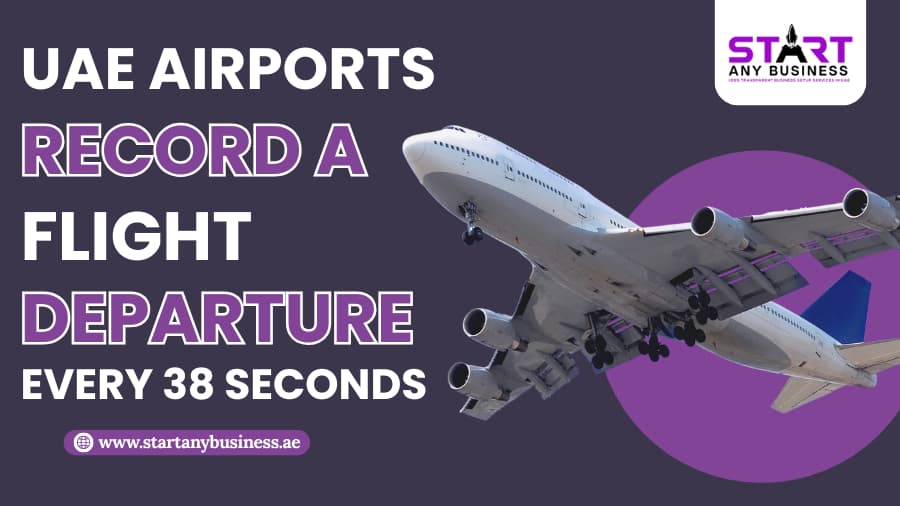
The United Arab Emirates’ sky is among the busiest in the world, a never-ending stream of activity that represents the country’s standing as a major international center for logistics, trade, and travel. According to recent data, UAE airports as a whole are currently handling an average of a flight departure every 38 seconds, which is a startling figure for this aviation dominance!
This amazing figure is more than just airport news in the United Arab Emirates; it is a potent illustration of the aviation industry’s vast infrastructure, strategic vision, and unwavering efficiency. Suppose you’ve ever been curious about the sheer volume of air traffic passing through the Emirates. In that case, this data explains the astounding numbers behind flight departures in the UAE, the dominance of Dubai International Airport traffic, and the factors that make the busiest UAE airports world champions.
The Staggering Numbers – Decoding the 38-Second Rate
Let’s examine the sheer volume of aircraft movements this represents throughout the entire network of UAE airports in order to put the statistic of a departure every 38 seconds into perspective –
- There are about 1.58 departures per minute.
- There are about 95 departures per hour.
- There are about 2,280 departures every day.
- Over 832,000 commercial flight departures occur annually.
This number includes all of the main commercial airports in the United Arab Emirates, such as –
1. Dubai International Airport (DXB) – The unchallenged leader and the main source of most traffic.
2. Abu Dhabi International Airport (AUH) – An international hub that is growing quickly.
3. Sharjah International Airport (SHJ) – An essential hub for low-cost and cargo airlines.
4. Al Maktoum International Airport (DWC) – Al Maktoum International Airport (DWC) is a secondary airport in Dubai that specializes in cargo and charter flights and is slated for significant growth.
The smooth coordination between air traffic control, ground crews, security, and airline operations that characterizes the UAE air traffic report is highlighted by this intense, high-frequency operation.
DXB – The Unrivalled Engine of Global Air Traffic
Dubai International Airport (DXB) handles the great majority of flight departures and general traffic. DXB’s operational performance is nothing short of legendary, and it has been the busiest airport in the world for international passenger traffic for a number of years.
Why DXB is the Dominant Force –
1. Home of Emirates – DXB naturally manages a huge number of flights as the hub for Emirates Airlines, one of the biggest airlines in the world. Dubai is a vital global crossroads because Emirates connects it to more than 150 destinations worldwide.
2. Strategic Location – DXB is the perfect stopover point for long-distance travel due to its central location, which is ideally positioned between the East and the West. Dubai International Airport traffic has increased due to this strategic advantage, which guarantees a steady demand for transfer flights.
3. Unmatched Efficiency – DXB routinely receives high operational efficiency ratings despite its enormous volume. The airport infrastructure and air traffic management systems are built to manage high-density operations, reducing delays and maintaining a steady and seamless flow of flight departures in the UAE.
Post-Pandemic Bounce Back –
Given the difficulties facing international aviation, the recent record departure rate is even more astounding. The quick recovery and expansion of Dubai International Airport traffic show how resilient the UAE market is and how much demand there is for travel to and through Dubai worldwide. DXB is positioned for a quicker and more robust recovery than many rivals thanks to the government’s proactive handling of the health crisis and openness to foreign tourism.
Strategic Vision – Why the UAE Invests Heavily in Aviation
The remarkable speed at which flight departures in the UAE is not coincidental. It is the outcome of a purposeful, long-term national strategy to position the Emirates as the top travel, tourism, and logistics destination in the world.
1. The Booster for the Economy
The UAE’s non-oil economy relies heavily on aviation, which boosts GDP. Hotels, restaurants, retail establishments, and real estate all benefit from the influx of tourists, investors, and businesspeople that each flight departure brings in. A thriving, diverse economy is reflected in the high volume of UAE air traffic reports.
2. Infrastructure Investment
The busiest airports in UAE are constantly growing and improving.
- DXB Modernization – Despite its size, DXB is continuously being improved to accommodate more travelers and planes. This includes increasing the number of terminal gates and enhancing runway effectiveness.
- The DWC Future – The ultimate plan calls for moving the majority of passenger traffic to Al Maktoum International Airport (DWC), which is expected to grow to be the world’s largest airport with capacity for well over 200 million passengers per year. The UAE’s prediction that air travel will only increase is supported by this expansion.
3. Open Skies Policy
In order to reduce restrictions on foreign airlines operating routes to and from the United Arab Emirates, the UAE actively negotiates “open skies” agreements with countries all over the world. The high frequency of UAE airport news and flight departures from Dubai airport is directly related to this policy, which maximizes competition and connectivity.
Beyond Dubai – The Other Power Players
The other UAE airports play crucial, specialized roles in handling the enormous volume of air traffic, despite DXB’s dominance.
1. Abu Dhabi International Airport (AUH)
Etihad Airways’ hub, Abu Dhabi International Airport (AUH), is expanding quickly throughout the world. Its magnificent new Midfield Terminal Complex (MTC) is a cutting-edge facility built to accommodate millions more passengers, significantly expanding the number of flights that can depart from the capital of the United Arab Emirates. Abu Dhabi frequently prioritizes high-end travel and connecting important, strategic international locations.
2. Sharjah International Airport (SHJ)
As the primary hub for Air Arabia, the first and biggest low-cost airline in the Middle East and North Africa, SHJ is an essential route for the region’s cargo operations. It is a distinct type of economic driver because of its emphasis on cost-effectiveness and effective cargo handling, which guarantees that every aspect of air travel contributes to the overall UAE air traffic report.
3. Coordinating the Sky
The control towers of these numerous busiest airports in the United Arab Emirates must coordinate extremely well in order to achieve the efficiency that permits an average departure every 38 seconds. The smooth rate of Dubai airport flight departures is directly impacted by the extremely complex flight paths that air traffic controllers must manage over a comparatively small geographic area in order to ensure safety and minimize holding patterns.
What This Means for the Future
The recent record pace of UAE airports isn’t only a high point, it is the baseline for future expansion. The momentum made by this level of functional effectiveness has a deep ripple impact –
1. Attraction of Talent – The booming aviation industry attracts talent from around the world, including engineers, pilots, and hospitality workers, which boosts the economy.
2. Trade and Logistics Advantage – The Emirates’ status as a vital logistics hub, essential for e-commerce and swift international trade, is reinforced by the high frequency of air freight departing from the country.
3. Enhanced Tourism – More flights translate into easier access to destinations, which makes the UAE a more appealing destination for travelers and benefits the hospitality industry as a whole.
The fact that a flight departs every 38 seconds is a potent representation of the United Arab Emirates’ aspirations to be a global leader. It presents an aviation industry that is actively setting the pace rather than just keeping up with global demand. The busiest airports in UAE, particularly Dubai International Airport, will continue to be the vital infrastructure connecting the world as it grows more interconnected. The UAE’s sky is getting busier, and it’s an exciting sight!