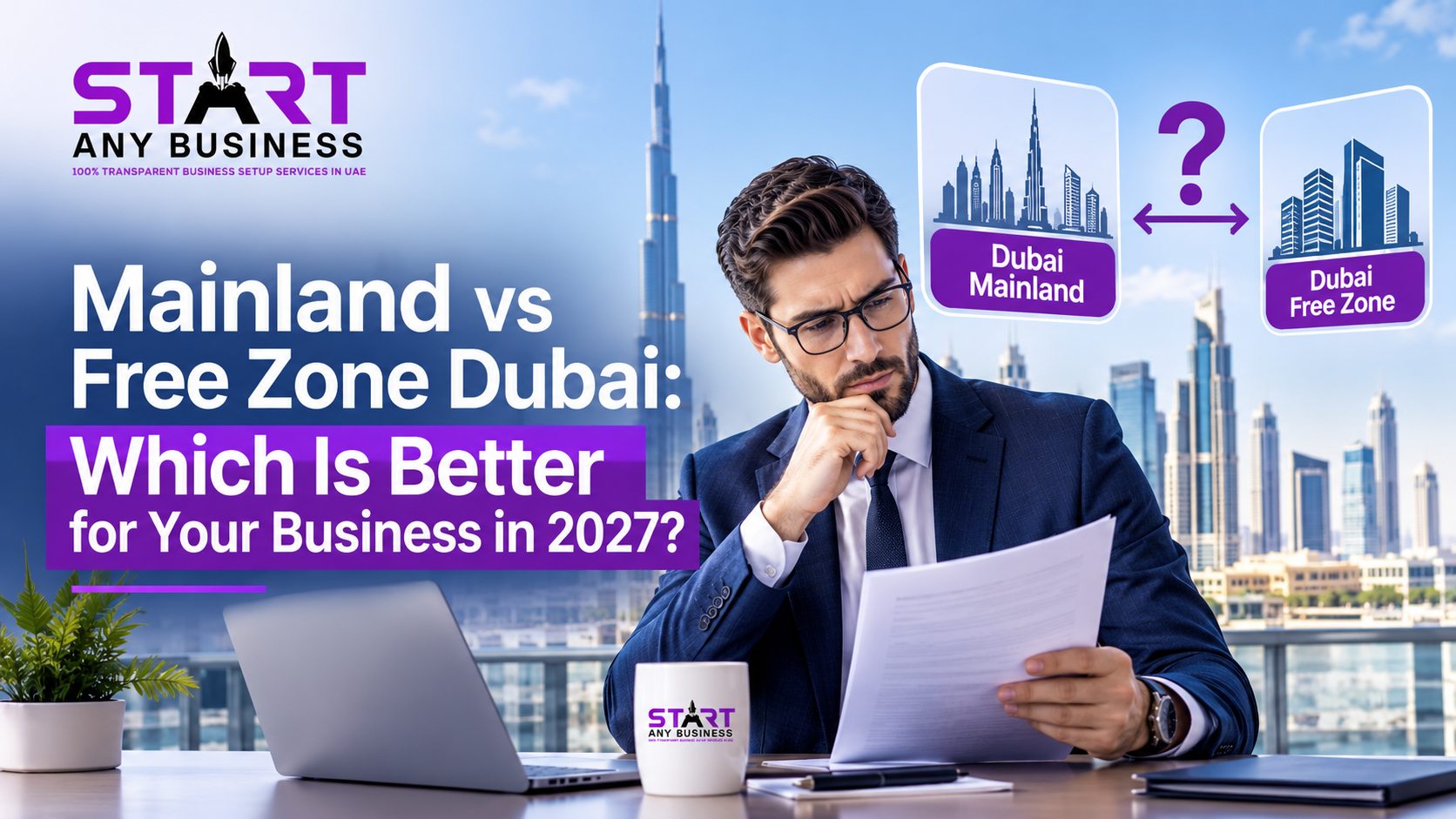
Deciding between mainland and free zones is often the first critical step for a new business owner in Dubai, impacting many future decisions such as where to sell or what office to rent and whether to obtain visas or not – in general, it determines how much your business set up will cost. The difference between the mainland and free zones comes down to ownership rules, market access, licensing authority, and the operational rules in practice.
A mainland business is set up through a license from the relevant UAE authority (Department of Economic Development), which allows operating anywhere in the UAE. A free zone business, on the other hand, is licensed by a particular free zone authority and operates following its internal regulations – free zones are preferable for companies engaged in international trade. The best choice for a business between the two options depends on the business model they intend to use. This will help make a choice.
Quick Comparison: Dubai Mainland vs Free Zone
Here’s the difference between mainland and free zone Dubai options at a glance:
| Factor | Dubai Mainland | Dubai Free Zone |
|---|---|---|
| Licensing Authority | Department of Economy and Tourism (DET) | The free zone’s own authority (e.g. DMCC, JAFZA, IFZA) |
| Selling to UAE Customers | Direct, across the UAE | Mainland activities may require additional licences, permits or approved distribution arrangements, depending on the business activity. |
| Range of Activities | Very wide | Limited to the activities each zone licenses |
| Office | Physical premises with a registered tenancy (Ejari), size depending on activity | Flexi-desk, shared or private office, depending on the package |
| Visa Allocation | Linked mainly to office size and activity | Linked to the package and workspace |
| Customs on Goods | Duty paid when goods enter the UAE | Customs advantages may apply to eligible goods stored or re-exported under applicable free zone and customs rules. |
| Industry Focus | General | Many zones target specific sectors |
1. What Is a Dubai Mainland Company?
A Dubai mainland company is registered and licensed in Dubai and is not based in any free zone. This type of company can open shops, warehouses, and offices anywhere in Dubai. It is also permitted to sell its products to organizations and consumers across the UAE and holds the rights to bid for any government or semi-government contract for which it qualifies.
Advantages of Dubai Mainland Company Registration
- Unrestricted access to the UAE market: The mainland company is allowed to carry out its respective offered activities in the UAE based on the respective license.
- Opportunities to be involved in more activities: The Department of Economic Development is known for issuing licenses for various professional, commercial, and industrial sectors that are uncommon in free zones.
- Freedom of choosing the location: Companies can select any location for their company, commercial shop, or office.
- Access to public-sector work: many government and semi-government tenders are open mainly to mainland-licensed suppliers.
- Room to expand across emirates: branches in other emirates can be added with the relevant local approvals.
For step-by-step setup details, see our Dubai Mainland Business Setup service page.
2. What Is a Dubai Free Zone Company?
A Dubai free zone company is registered in a designated economic zone and licensed by that zone’s authority. Dubai has a large number of free zones, and each sets its own activity list, packages and fees. Well-known examples include:
- DMCC: commodities, trading and a broad mix of services.See our DMCC Free Zone setup guide.
- JAFZA: logistics, manufacturing and large-scale trading next to Jebel Ali Port
- IFZA: cost-conscious packages for consultancies and service firms
- Meydan Free Zone: fully digital setup for small businesses and startups
- Dubai Silicon Oasis: technology and innovation companies
- Dubai South: aviation, logistics and e-commerce near Al Maktoum International Airport
- DIFC: financial services, regulated by the DFSA, with its own common-law courts
Key Benefits of Dubai Free Zone Company Formation
- Sector clusters: sit alongside suppliers, partners and clients in the same industry.
- Bundled packages: Many free zones offer packages combining business licensing with selected workspace and visa options, helping entrepreneurs compare initial setup requirements.
- Flexible workspace: start with a flexi-desk and move to a larger office as you grow.
- Customs advantages for goods: Eligible goods stored or re-exported through certain free zones may benefit from customs arrangements, subject to applicable conditions.
- Quicker, often online setup: many authorities handle registration end to end through their own portals.
For package and zone comparisons, see our Dubai Free Zone Business Setup service page.
3. Difference Between Mainland and Free Zone Company Formation in Dubai
The table above gives the headline view. Here’s what each difference means for mainland vs free zone company formation in practice.
A. Business Activities and Market Access

This usually is the decisive factor for any comparison between Dubai Mainland versus Free Zone. A mainland company can sell its licensed products or services to anyone in the UAE.
A free zone company can transact its allowed businesses within its own region and serve international clients. However, in general, operating in mainland Dubai may call for additional approvals.
Following the execution of Dubai Executive Council Resolution No. 11 of 2025 concerning various arrangements that free zone companies eligible might apply for:
- Mainland branch licence: An independent branch inside mainland Dubai.
- Branch operating from the free zone: Conduct of approved mainland activities through a branch based on the free-zone address.
- Temporary permit: Authorization to carry out certain approved activities for a period of up to six months.
These arrangements are contingent upon the permitted activities and the authority’s approvals.
The routes cover only activities on the DET’s approved list, apply to Dubai alone (not other emirates), and exclude financial firms in DIFC. Companies availing themselves of these routes will do so with separate financial records for their mainland work.
B. Foreign Ownership
As of 2021, the majority of mainland companies can have an ownership level of 100% foreign investment and do not have to partner with any local business. However, certain types of businesses that have strategic implications, such as those dealing with defense and security issues, banking, insurance and telecommunications have restrictions on foreign ownership or need special approvals. Companies that operate in the free zones have always been allowed to fully engage in economic activities with foreign investment.
C. Space for Office
Mainland companies need to possess approved commercial premises and the necessary tenancy documents while particular requirements depend on the kind of license and the type of business activity. Free zone companies are more flexible initially. Many of them provide the option of a flexi-desk or shared office, which can be more than enough for consultants, companies providing agency services, or online businesses. Nevertheless, manufacturing and some other kinds of activities require a separate unit within the free zone.
D. Employee Visas and Visa Allocation
On the mainland, the number of visas you can apply for is linked mainly to the size of your registered office and your activity, so growing the team often means moving to larger premises.
In a free zone, the visa quota is usually fixed by the package. A flexi-desk package may allow only a small number of visas, so if you plan to hire quickly, check how much it costs to upgrade before you commit.
E. Business Licence and Registration Process
| Step | Mainland | Free Zone |
|---|---|---|
| 1 | Choose activity and legal form | Choose the free zone and activity |
| 2 | Reserve the trade name and get initial approval from the DET | Submit shareholder documents and the application to the authority |
| 3 | Arrange the required premises and tenancy documentation | Choose a workspace package |
| 4 | Get any external approvals (e.g. health, education, police) | Get any activity-specific approvals |
| 5 | Pay fees and receive the trade licence | Pay fees and receive the licence and establishment card |
Mainland setup typically involves more separate authorities. Free zone setup is often handled under one roof, with most steps completed online.
F. Accounting and Audit Obligations

Mainland and free zone companies must maintain proper accounting records and comply with applicable UAE Corporate Tax registration and reporting requirements, subject to relevant exemptions and exceptions.
Some free zone authorities require audited financial statements for licence renewal. Qualifying Free Zone Persons must also meet the applicable audited financial statement requirements.
Under UAE Corporate Tax rules, taxable persons with annual revenue exceeding AED 50 million generally need audited financial statements. Other businesses may also require audits depending on their legal structure, licensing authority or regulatory obligations.
4. Mainland vs Free Zone Business Setup Cost
On cost, mainland vs free zone Dubai has no automatic winner. The total depends on your activity, space and team size, so compare full quotes rather than headline prices.
Mainland cost factors
- Trade name, initial approval and licence fees
- Office or shop rent and Ejari registration
- External approvals for regulated activities
- Establishment card and immigration charges
- Employee visa and medical fees
Free zone cost factors
- Registration and licence package
- Flexi-desk or office fees
- Establishment card
- Visa allocation and processing
- Extra activities, approvals or annual audit
Workspace costs can be a major difference, particularly when comparing a mainland company requiring dedicated premises with a free zone business using a flexi-desk package. However, the cost difference may change as the company expands, hires more employees or needs additional facilities. Always compare first-year expenses with annual renewal costs before choosing a setup. For more information, see our guide to the cost of setting up a business in Dubai.
5. Corporate Tax: Is Mainland or Free Zone Better?
UAE Corporate Tax generally applies at 0% on taxable income up to AED 375,000 and 9% on taxable income above that amount. However, qualifying free zone businesses are subject to a different tax treatment.
A Qualifying Free Zone Person (QFZP) may benefit from a 0% Corporate Tax rate on qualifying income, while taxable income that does not qualify is generally subject to 9% without the standard AED 375,000 tax-free band.
To retain this status, the company must meet conditions relating to qualifying income, adequate substance, non-qualifying revenue limits, transfer pricing and audited financial statements.
Income earned from mainland customers is not automatically treated the same in every situation. Its tax treatment depends on the activity, nature of the transaction and applicable qualifying-income rules.
So on the mainland vs free zone Dubai tax question, a free zone only gives an advantage if your income is the right kind. A business selling mainly to UAE consumers may pay the same, or even more, than it would as a mainland company. Check the Federal Tax Authority’s guidance or speak to a tax adviser before choosing based on tax alone.
6. Mainland vs Free Zone Dubai: Which Suits Your Type of Business?
There’s no fixed rule for Dubai mainland or free zone by industry, but some patterns are clear:
| Business Type | Usual Fit | Why |
|---|---|---|
| Retail shop or showroom | Mainland | Needs a street-level store and walk-in UAE customers |
| Restaurant or café | Mainland | Serves the local public from a physical outlet |
| Construction or fit-out contractor | Mainland | Works on sites across the UAE and often bids for local projects |
| Re-export and international trading | Free Zone | May benefit from customs arrangements for eligible stored and re-exported goods |
| Consultancy with overseas clients | Free Zone | Flexible workspace and licensing options may suit international consultancy operations |
| Technology or SaaS startup | Either | Free Zone for a tech cluster; Mainland if selling mainly to UAE businesses |
| E-commerce | Either | Depends on where stock is held and whether you sell mainly to UAE consumers |
| Digital marketing agency | Either | Mainland if most clients are UAE businesses; Free Zone if most are abroad |
These are typical patterns, not rules. Always confirm that your exact activity is available, and what approvals it needs, before you register.
7. Dubai Mainland or Free Zone: Questions to Ask Before You Decide
Most mainland vs free zone Dubai decisions come down to six questions:
- Where will most of your revenue come from? Mostly UAE customers points to the mainland; mostly international customers points to a free zone.
- Is your activity available, and does it need outside approvals? Some activities exist only on the mainland, others only in certain zones.
- Do customers need to visit you? Walk-in businesses usually need mainland premises.
- How many people will you hire in the first two years? Compare the visa quota and the cost of upgrading it.
- What’s your budget for year two, not just year one? Renewals, rent and visa costs repeat every year.
- Will you work with government or semi-government clients? Mainland licensing usually makes tenders easier to access.
8. Can You Change From Free Zone to Mainland Later?
It is determined by the type of business structure a company is currently using, what sort of licensing authority it has and the upcoming business activities. Some of the options for the organization are either to set up a new company at the mainland level, start a branch or to find out if a required license could be obtained.
Before taking the steps towards a new business structure, make sure to check what effect it will have on existing contracts, bank accounts, employee visas, tax registration or any lease agreements. Advance planning will ensure that you won’t be paying for two premises for long.
9. Conclusion: Free Zone or Mainland Dubai
If you are in need of direct contact with UAE customers, doing physical operations or obtaining government contracts, then going for Dubai mainland could be the best choice. In case you are involved in international trade, special activities or need more flexible environment, Free Zone might be a better option for you. But obviously not all the time one of the mentioned variants is preferable. You need to analyze your activities, the amount of clients and your future expansion before making the right decision.
Start Your Business in Dubai With the Right Structure

Not sure where you land on mainland vs free zone Dubai? Start Any Business UAE helps entrepreneurs compare both options, choose the right activity and zone, and handle registration, licensing and visas from start to finish. Share your business requirements with Start Any Business UAE to compare suitable mainland and free zone options, understand licensing requirements and review estimated setup and renewal costs.
Frequently Asked Questions
1. Can I own both a mainland company and a free zone company in the UAE?
Yes. An individual or business group can own both mainland and free zone companies, subject to the applicable licensing and ownership requirements. Each entity must maintain its own legal and compliance obligations, while workspace requirements depend on the selected jurisdiction and business activity. Transactions between related companies may also be subject to transfer pricing rules.
2. Does a free zone company need to register for VAT?
Yes, a free zone company may need to register for VAT if it meets the applicable registration conditions. Mandatory registration generally applies when taxable supplies and imports exceed AED 375,000 over the previous 12 months or are expected to exceed that amount within the next 30 days. Voluntary registration may be available from AED 187,500, subject to eligibility requirements. Certain VAT Designated Zones have special rules for qualifying goods transactions.
3. Can I include multiple business activities under one Dubai trade licence?
Yes, some mainland and free zone licences allow multiple business activities, provided the relevant licensing authority permits their combination. Certain activities may require additional approvals or separate licences. Businesses should confirm the approved activity list and any extra fees before applying.
4. Which is better for freelancers in Dubai?
Both mainland and free zone arrangements may be suitable for freelancers, depending on the permitted activity, licensing requirements, client base and budget. Some free zones offer freelance permits or small business packages, while eligible mainland licensing options may also be available. Compare the total costs and permitted activities before choosing.
5. Is it easier to open a bank account with a Dubai mainland or free zone company?
Banks accept both. What matters more is your activity, the shareholders’ profiles and proof of real operations, such as a lease, contracts and expected transactions. Companies with a physical office and clear business plans usually find the process smoother.